
Consumer & everyday bullshit
Funny how the website works until you try to cancel.
Instant signup, an obstacle course to leave, and a welcome step from New York City toward making companies cut the crap.
Join the discussion →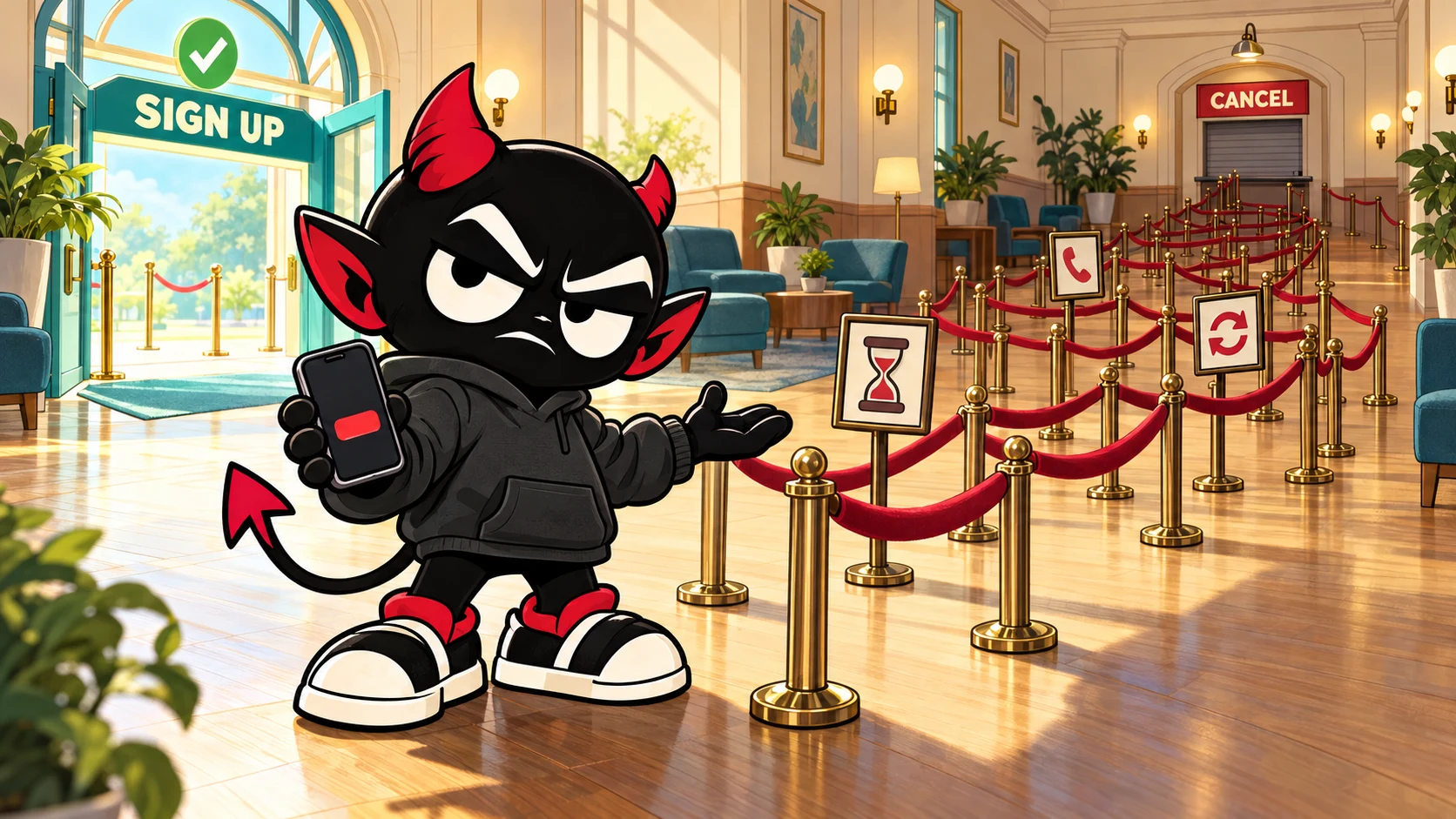
Your card goes through immediately. No phone call, no business hours, no conversation about whether this subscription fits your goals.
Try to cancel, though, and suddenly we need to talk.
Apparently our relationship only became important when I stopped wanting to pay for it.
There's a particular kind of bullshit in having to convince a company to stop selling you something. You've decided you don't want it. You've found the account page. You're signed in. That ought to be enough to get the process moving without a conversation about how much you'll miss the premium features.
And if you signed up on a website, being told to call somebody to leave is a hell of a sudden loss of technical capability.
I build software. I know there are legitimate reasons to verify an account or warn someone before they lose access to something important. But I have very little patience for a cancellation process that keeps asking whether you're sure, then offers you a discount, then makes you find another button before it finally accepts the answer.
At some point, the extra steps need a better explanation than "customer experience."
You still have to find time to get through it
Consider a cancellation flow that takes long enough that someone puts it off until lunch. Lunch gets busy, so it becomes an after-work job. By the time they remember again, the next payment has gone through.
That's a hypothetical, but it explains why the number of steps matters. A person can fully intend to cancel and still get charged again if the process demands more time than they have available right then.
The same goes for a required phone call during working hours. The business has made its staffing schedule part of your ability to stop paying. Now you need to find time to call, wait, verify yourself and explain a decision you've already made.
A company can describe the resulting account as retained. I'd want to know how many of those customers actually chose to stay and how many simply haven't finished getting out.
Those are very different things to be pleased with yourself about.
Monthly payments aren't always a monthly subscription
Adobe is a useful example because there's a real distinction worth understanding underneath the anger.
Its current U.S. help page describes an annual plan paid monthly, with an early cancellation fee of 50% of the remaining contract balance after the initial 14-day period. Paying each month doesn't make that plan a month-to-month agreement. Adobe's cancellation terms
A cheaper price in exchange for a year-long commitment can be a legitimate offer. The customer needs to understand that commitment while deciding whether to buy it. If leaving early costs money, that deserves to be visible alongside the price, before anyone enters their card details.
The government's case against Adobe concerned allegations that important terms, including an early termination fee, were hidden in fine print and inconspicuous links, and that cancellation involved unnecessary steps and delays. In March 2026, the Justice Department announced a proposed settlement with $75 million in civil penalties and $75 million in free services for customers. That $150 million headline wasn't $150 million in cash refunds. DOJ announcement
Adobe denied wrongdoing and said its terms were transparent and its cancellation process simple. Adobe's response
A customer should be able to compare the actual deal before buying it. The moment they try to leave shouldn't be the moment the commitment finally becomes clear.
New York is taking a step in the right direction
On October 1, 2026, New York City's click-to-cancel rule took effect. The city's guidance says businesses must explain subscription terms clearly and provide a straightforward cancellation process through the same method used to sign up. It specifically gives being forced to cancel by phone after signing up online as a reason to complain. NYC consumer guidance
Good. That's a step in the right direction.
If a business can accept the signup online, expecting it to handle the cancellation online is pretty reasonable. Somehow we've reached the point where that needs a rule and the possibility of financial penalties.
The city says fines start at $525 per violation and has launched a complaint portal. This is a New York City measure, not a new nationwide guarantee. It's also too early to declare that it has fixed the problem. Enforcement and what customers actually experience will matter. October 1 announcement
Still, giving people somewhere to report this behavior, backed by an agency that can act, is welcome. "Contact customer service" is a less satisfying answer when customer service is the thing you're trying to get past.
Make the cancellation button do its job
My standard for a decent process is fairly boring. Let me find cancellation in my account, show me any genuine consequences and let me confirm. Then tell me it's done.
Be specific about when billing stops, how long access continues and any remaining obligation. Send a confirmation I can keep. Don't leave me trying to work out whether I cancelled, merely requested cancellation or successfully booked a conversation about potentially cancelling.
A discount can be useful. I'd be happy to see an optional offer alongside a clear way to continue cancelling. I object when declining it just starts another round of persuasion. The company can want my business without making me repeatedly defend my decision.
And please don't call a cheaper price available only at the exit a reward for loyalty. The loyal customer was paying the higher price yesterday.
Someone leaving might be finished with a project, cutting expenses or simply not using the product. A cancellation process doesn't need to extract a sufficiently moving explanation before it works.
If the company wants feedback, it can ask after the cancellation is complete. I'll decide whether I have time to answer. Stopping the bill shouldn't depend on me completing an exit interview.