
AI & creativity
Someone else's idea, now with your logo.
An impressive production process can still start with a lousy creative brief: find somebody else's successful video and make our version.
Join the discussion →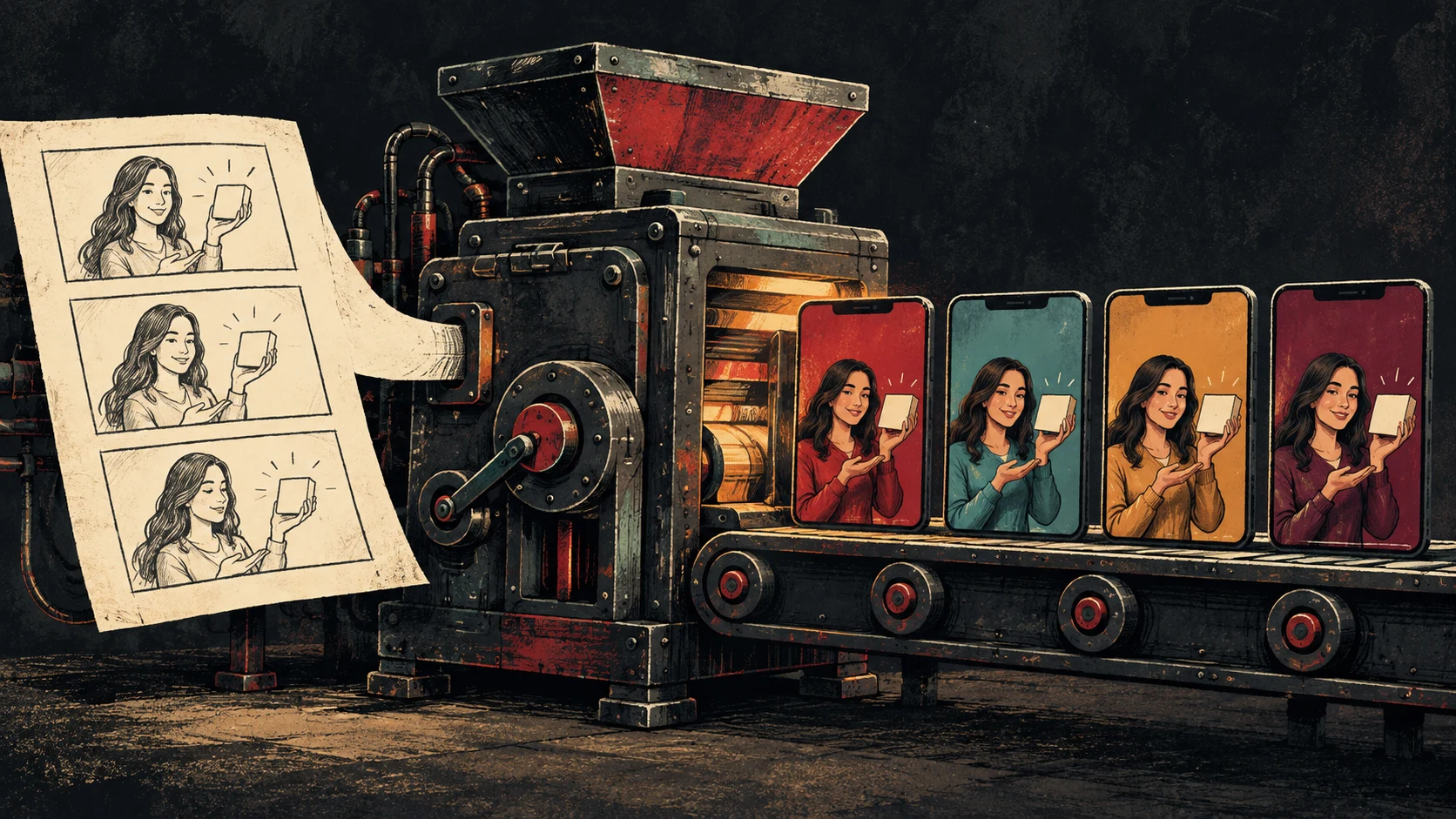
I read a pitch for an AI tool that can take a video you like and rebuild it around your product. Pick the video, choose an avatar and tell it what to change. It'll analyze the scenes, write a new concept and generate the footage.
The pitch stressed that this wasn't just a face swap. The system would write a description of the scenes, then use that description to generate new footage. It wouldn't reuse the original footage.
That's an impressive amount of engineering to arrive at "I'll have what they're having."
We've got tools that can help someone without a production budget make something they couldn't have attempted before. The exciting demonstration is that we can use them to remake somebody else's post. Apparently the thing holding us back was having to do the copying ourselves.
The pixels weren't the interesting part
When the reference is somebody else's finished work, there's more to borrow than footage. Somebody noticed a situation worth making a video about. They worked out where to start, what to leave out and when to deliver the payoff. The fact that you can describe those decisions in a prompt doesn't make them yours.
Imagine someone makes a funny video about canceling a subscription. The humor comes from how a simple request turns into an increasingly ridiculous conversation. Another business rebuilds the same sequence with a different person and drops its own product into the ending.
Every frame could be new. The reason to watch it could still have come almost entirely from the first person.
I'd still like to know what you brought to the video beyond a product that needed advertising.
And I understand the commercial temptation. A successful video comes with evidence that people watched it. Your own untested idea comes with the possibility that nobody will give a shit. Choosing the reference can feel like a sensible business decision, even though its success doesn't guarantee yours.
That's the part worth being honest about. The appeal is getting to start after somebody else has taken the risk of finding out whether the idea works. Calling the machinery creative doesn't tell me much about the ambition of the person operating it.
More output doesn't mean more variety
A March 2026 PNAS Nexus study compared 22 language models with 102 people on three creativity tests. The models could produce creative answers, but their answers were much more alike than the people's answers were. These were tests using words, not videos. The useful finding is that an answer can be good on its own while looking a lot like the other answers. More output doesn't necessarily give us more to choose from.
A separate study published in 2026 tested a different approach. Researchers gave people a deliberately varied set of AI-generated story ideas to write from. They found that the resulting stories were about as varied as stories written without AI suggestions. That gives us a reason to pay attention to how we use the tools, rather than assuming AI always makes everything the same.
Those studies don't tell us what replication tools are doing to our feeds. But with the workflow in that pitch, similarity is something the customer asks for. They select a finished video because they want their version of it. Getting close is part of the brief.
We've had to ask this about our own game
I've been exploring a game for Club Spite with AI, using other games to explain the pace, movement and visual quality I'm after. I've also kept coming back to the same concern: we could do a load of work and end up with essentially the same game in different scenery, with a different character.
AI makes that surprisingly easy to keep doing. We can change the character, improve an attack and try another setting. There will be something new to look at. Whether there's a good reason to play our game is a less convenient question, and another round of nicer graphics won't answer it for us.
I don't get a pass on that because it's my project.
References are useful. Games share conventions because players understand them and because some of them work really well. Nobody needs us to reinvent walking. But if we want somebody to spend an evening playing our game, "we changed the character" is a pretty weak case to make.
The same goes for a video. A familiar format can be a good way to tell a story you actually have. Once the other person's story, pacing and payoff are supplying most of the interest, changing the face and the product starts to look like a very small contribution.
The audience still has to watch it
The promise is that production takes minutes. Fine. That saves time for the person filling the account. It doesn't make the resulting video worth anyone else's time.
For the viewer, the repetition becomes apparent after they've already started watching. Give enough businesses cheap versions of a successful idea and you can imagine the result: a lot of slightly different people delivering a joke you've already heard, each with something different to sell you. I don't particularly want to help make that experience more efficient.
We could use that cheaper production to tell a story a small business couldn't previously afford to film. Or we could keep generating new people to perform somebody else's idea. If the best thing we can say about our version is that it advertises our product instead, I don't see why the audience should care.